How to Choose the Perfect Manual Food Chopper for Your Kitchen: A Complete Buyer's Guide
By OneIDDeal™ | Published: 2026-06-23
Category: How-to Guides
Discover how to pick the best manual food chopper for your kitchen. Compare hand-powered choppers, learn key features, and find affordable kitchen gadgets that simplify meal prep.
If you spend any time in the kitchen, you know that chopping vegetables, nuts, and herbs can be one of the most repetitive and time-consuming tasks. While electric food processors get the job done, they often take up precious counter space, require electricity, and can be a hassle to clean. That's where a manual food chopper comes in. These hand-powered gadgets are compact, budget-friendly, and surprisingly effective for everyday prep. Whether you're dicing onions for salsa, mincing garlic for a stir-fry, or chopping nuts for a salad, the right manual chopper can save you minutes every day. In this guide, we'll walk you through everything you need to know to choose the perfect hand powered food chopper for your kitchen, from design and blade types to ease of cleaning and value. And because we love affordable kitchen solutions, we'll highlight some of the best affordable kitchen gadgets you can find on OneIDDeal™.
Why Choose a Manual Food Chopper Over an Electric One?
Before diving into the selection criteria, let's look at why a best vegetable chopper that runs on human power might be the right choice for you. Manual food choppers are typically smaller and lighter than their electric counterparts, making them ideal for small kitchens, dorm rooms, or RVs. They don't need a power outlet, so you can use them anywhere—even at a picnic table or on a camping trip. They're also quieter, which is a big plus if you're prepping meals early in the morning or late at night. Plus, most manual choppers are easier to clean: many are dishwasher-safe and have fewer parts than electric models. Finally, they are usually much more affordable, often costing under $20. This makes them a go-to for anyone looking for affordable kitchen gadgets that deliver real value.
Key Features to Look for in a Manual Food Chopper
Not all manual food choppers are created equal. Here are the critical factors to consider when shopping for the best vegetable chopper for your needs.
1. Mechanism Type: Pull-Cord vs. Press-and-Twist vs. Rocker
Manual choppers generally fall into three categories based on how they operate:
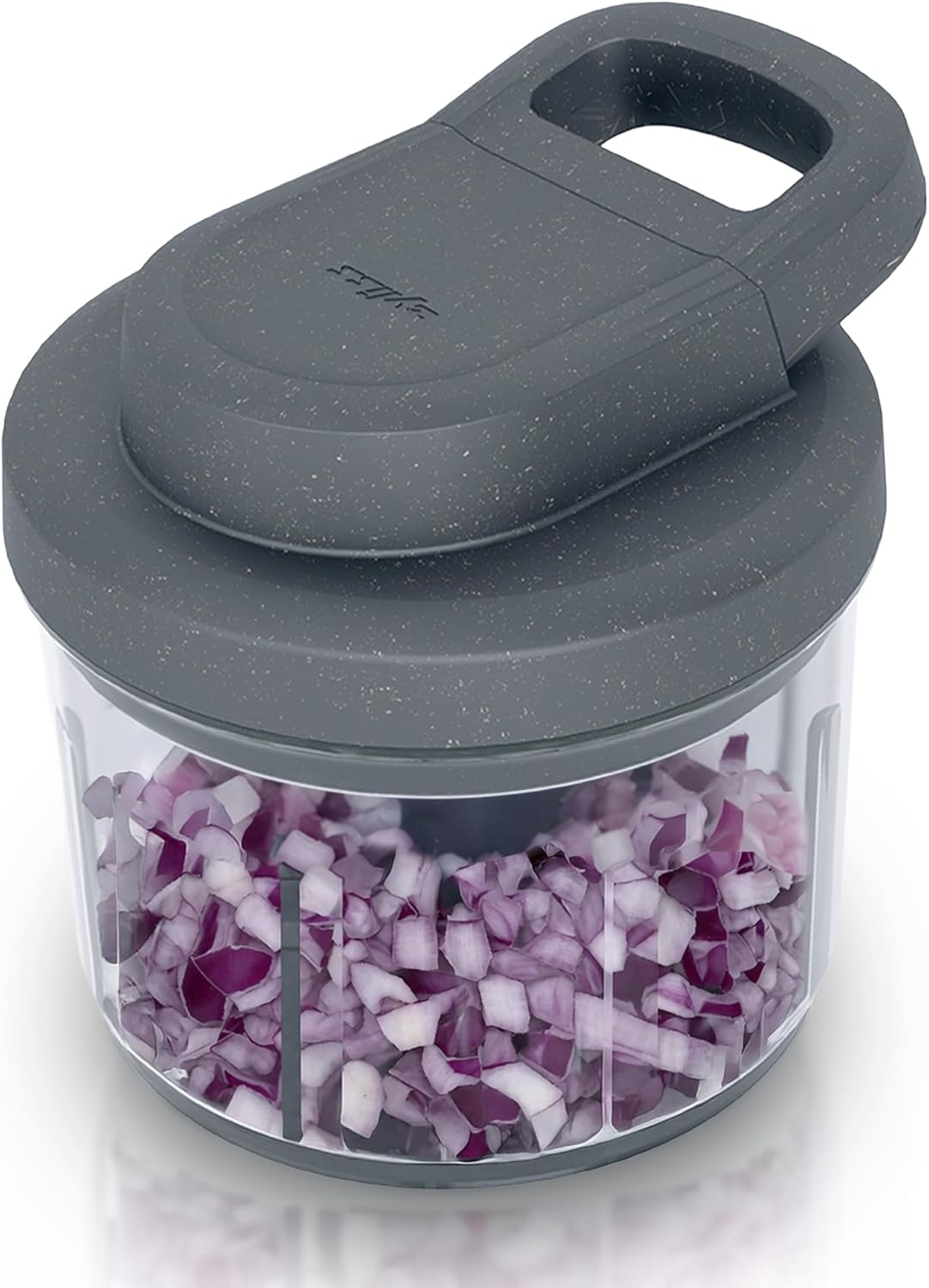
- Pull-cord choppers: These use a pull-cord mechanism (similar to a lawn mower starter) to spin the blades. They are very common and allow for continuous chopping with a simple pull. The Zyliss Easy Pull Food Chopper and Manual Food Processor - Hand-Held Slicer & Dicer for Fruits & Vegetables - Easy Pull Manual Food Chopper - Cooking Gadgets & Kitchen Essentials - Easy Pull 3.0 is a classic example—just pull the cord a few times, and your onions are perfectly diced in seconds. These are great for small to medium batches.
- Press-and-twist choppers: You push down on a top handle that twists the blades as it descends. These can be a bit more ergonomic for some users, as the motion is similar to pressing a plunger. They often produce more consistent cuts but may require a bit more effort.
- Rocker choppers: These have a curved blade that you rock back and forth over the food, usually on a cutting board. They are excellent for herbs, nuts, and small amounts of vegetables, but are less efficient for large quantities.

For versatility and ease of use, pull-cord models like the Zyliss are often the top choice among home cooks.
2. Blade Material and Design
The blades are the heart of any hand powered food chopper. Look for stainless steel blades that are sharp, rust-resistant, and durable. Some choppers come with interchangeable blades for different cuts, such as coarse or fine chopping, or even julienne and slicing disks. If you often prep a variety of ingredients, a model with multiple blades can be a game-changer. However, for most daily tasks—dicing onions, chopping carrots, mincing garlic—a single set of sharp, curved blades (usually two or four) is sufficient.
3. Capacity and Bowl Size
Consider how much food you typically chop at once. Most manual choppers have a bowl capacity between 1 and 4 cups. For a single person or a couple, a 2-cup bowl is usually enough. For families, a larger bowl (3-4 cups) will save you from having to chop in batches. Keep in mind that you shouldn't overfill the bowl—leave some space for the blades to move and for the food to be tossed around.
4. Ease of Cleaning
One of the biggest advantages of a manual chopper over an electric food processor is how easy it is to clean. Look for models that are dishwasher-safe (top rack is common) or have a seamless, non-stick bowl that rinses clean easily. The Zyliss Easy Pull, for example, has a simple design with few crevices where food can get stuck, making it one of the easiest affordable kitchen gadgets to maintain.
5. Stability and Non-Slip Base
A manual chopper needs to stay put while you work. Check for a non-slip base or suction feet that grip the countertop. This is especially important for pull-cord models, where the pulling motion can cause the whole unit to slide around. A stable base ensures safety and efficiency.
How to Use a Manual Food Chopper: Quick Tips for Best Results
Once you've chosen your chopper, here are a few tips to get the most out of it:
- Cut food into uniform chunks before adding them to the bowl. For example, cut an onion into eighths rather than dropping a whole onion in. This helps the blades work evenly.
- Don't overfill the bowl. Leave at least an inch of space at the top for the food to move around.
- Use short, rapid pulls (or presses) rather than long, slow ones. This gives you more control over the final texture.
- For fine mincing, pull the cord 8-10 times. For a coarse chop, 4-5 pulls may be enough. Check the consistency as you go.
- Clean your chopper immediately after use to prevent food from drying and sticking.
Manual Food Chopper vs. Electric Food Processor: Which One Should You Buy?
This is a common dilemma. If you regularly chop large quantities (e.g., for batch cooking or big parties), an electric food processor like the SPZTJK 3-Speed Electric Food Processor: Meat Grinder, Vegetable Chopper & Baby Food Maker - 300W, 2 Bowls (8 Cup Stainless Steel+8 Cup Glass), Quiet Operation might be worth the investment. It can handle bigger loads and also grind meat or make baby food. However, for everyday tasks—dicing an onion, chopping a handful of nuts, making a small salsa—a manual chopper is faster, quieter, and easier to clean. Many home cooks own both: an electric processor for big jobs, and a manual chopper for quick, small-batch prep. If you're on a budget, start with a manual chopper and see if it covers 80% of your chopping needs.
Top Manual Food Chopper Picks on OneIDDeal™
To save you time, here are two excellent manual food choppers available at OneIDDeal™ that meet the criteria above:
| Product | Key Feature | Best For |
|---|---|---|
| Zyliss Easy Pull Food Chopper 3.0 | Pull-cord mechanism, sharp stainless steel blades, non-slip base, dishwasher-safe | Everyday chopping of onions, peppers, nuts, and herbs |
| SPZTJK 3-Speed Electric Food Processor | Electric, 2 bowls (stainless steel + glass), multiple blades, quiet operation | Heavy-duty chopping, meat grinding, baby food prep |
Both are highly rated and represent the best in their categories. The Zyliss is the perfect example of a hand powered food chopper that's incredibly user-friendly, while the SPZTJK offers electric power for those who need more capacity.
Common Mistakes to Avoid When Buying a Manual Food Chopper
- Ignoring the bowl size: A tiny bowl (under 1.5 cups) may frustrate you if you cook for more than one person. Always check the capacity.
- Choosing a chopper with poor stability: If the base doesn't grip the counter, the chopper will slide around, making it hard to use and potentially unsafe.
- Forgetting about cleaning: Some manual choppers have complicated parts that trap food. Read reviews about ease of cleaning before buying.
- Assuming all blades are the same: The sharpness and number of blades directly affect chopping speed and consistency. Look for at least two curved blades made of stainless steel.
Conclusion: Your Next Steps to Better Meal Prep
Choosing the perfect manual food chopper comes down to understanding your cooking habits, the volume of food you prep, and which features matter most to you. For most home cooks, a pull-cord model like the Zyliss Easy Pull Food Chopper offers the ideal balance of simplicity, speed, and easy cleanup—all at a price that makes it one of the best affordable kitchen gadgets you can own. If your needs lean toward larger batches or more versatility, consider an electric option like the SPZTJK processor. Either way, you'll save time and effort in the kitchen.
Ready to upgrade your meal prep game? Check out the Zyliss Easy Pull Food Chopper on OneIDDeal™ today and see how this compact tool can transform the way you chop, dice, and mince. It's a small investment that pays off every single time you cook.